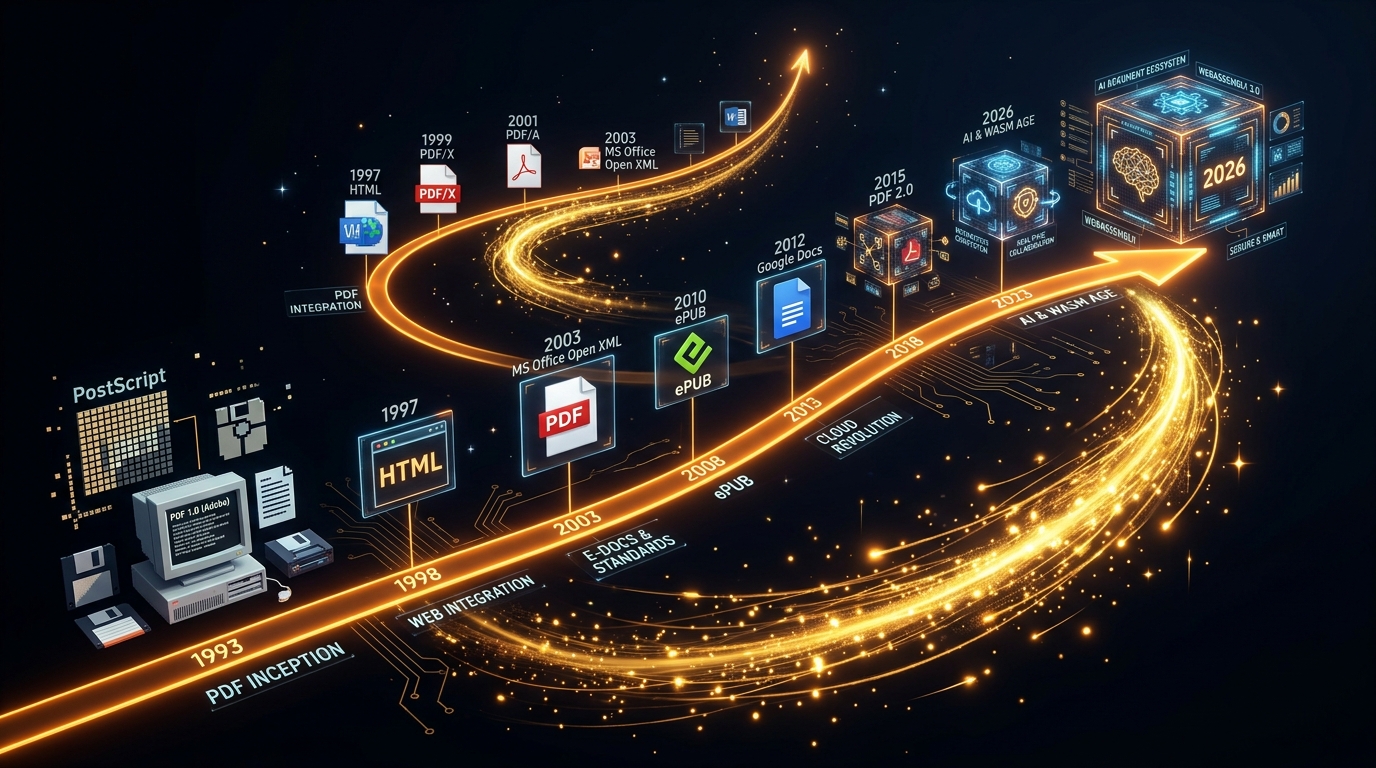
In the annals of computer science and digital publishing, few technologies have shaped human knowledge transmission as profoundly as the Portable Document Format (PDF). Over the course of more than thirty years—from the nascent personal computing revolution of the early 1990s to the artificial intelligence and cloud ecosystems of 2026—PDF has evolved from a proprietary corporate experiment into an open, globally standardized digital infrastructure that underpins modern law, science, governance, and business.
The journey of PDF is a fascinating historical chronicle of engineering vision, fierce technological competition, open standards diplomacy, and relentless adaptation. How did a format created to send digital faxes and print newspaper layouts evolve into a cryptographic, interactive, 3D-capable, and AI-searchable document architecture in 2026? In this comprehensive historical retrospective, we trace the definitive evolutionary timeline of PDF from 1991 to the present day, exploring every major milestone, standard revision, competing format battle, compression breakthrough, and technological evolution.
1. 1991–1993: Project Camelot and the Birth of PDF 1.0
The origins of PDF began in the fertile research laboratories of Adobe Systems in Mountain View, California. In the spring of 1991, Adobe co-founder and former Xerox PARC researcher Dr. John Warnock authored an internal research document titled "The Camelot Project."
At the time, personal computing was crippled by severe platform incompatibility. If a user designed a document on an Apple Macintosh with PostScript fonts and sent it to an IBM-compatible PC running MS-DOS or early Windows, the file was virtually unreadable. Warnock recognized that the world needed a "universal electronic paper" that could capture documents from any application, transmit them across any computer network, and render them with absolute visual fidelity on any screen or printer.
On June 15, 1993, Adobe officially launched Acrobat 1.0 and PDF Specification 1.0. The initial release introduced:
- The core 2D Cartesian coordinate rendering model.
- Support for embedded Type 1 PostScript fonts and standard 14 base fonts (Times, Helvetica, Courier, Symbol, Zapf Dingbats).
- Cross-platform viewing software for Macintosh, Windows 3.1, and DOS.
However, early adoption was slow. Adobe initially charged $50 for the Acrobat Reader viewing software and hundreds of dollars for the Acrobat Exchange creator software. In an era of dial-up modems where a 2MB PDF took twenty minutes to download, many industry analysts dismissed PDF as too bloated for practical use.
2. 1994–1999: The Web Revolution and Acrobat Reader Goes Free
Recognizing that charging for a document reader created an insurmountable barrier to network adoption, Adobe made a pivotal strategic decision in 1994 with the release of PDF 1.1 and Acrobat 2.0: they made the Acrobat Reader software 100% free.
This single decision ignited exponential adoption across the emerging World Wide Web. As government agencies (such as the US Internal Revenue Service) and universities began distributing official tax forms and academic papers as downloadable PDFs, the format became an essential web companion.
Key technological breakthroughs during this decade included:
- PDF 1.2 (1996 / Acrobat 3.0): Introduced in-browser Netscape Navigator and Internet Explorer web browser plugins, interactive form fields (AcroForms), and TrueType font embedding.
- PDF 1.3 (1999 / Acrobat 4.0): Introduced 2-byte CID-keyed international fonts for East Asian CJK typography, 40-bit RC4 password encryption, and native support for digital color prepress workflows.
3. The Evolution of PDF Data Compression Algorithms
A major technical hurdle throughout PDF's history was file size management. Over the decades, PDF integrated cutting-edge compression algorithms that allowed rich, multi-page visual documents to transfer over increasingly fast networks:
- LZW (Lempel-Ziv-Welch) Compression: Used in early PDF 1.0–1.1 for text and monochrome graphics. Later phased out due to early Unisys patent licensing restrictions.
- Flate / Deflate Compression: Introduced in PDF 1.2, based on the open zlib algorithm. Remains the universal workhorse for compressing content streams, font dictionaries, and cross-reference tables.
- JBIG2 (Joint Bi-level Image Experts Group): Added in PDF 1.4 (2001) specifically for bi-level monochrome scanned text. Replaced CCITT Group 4 fax compression, delivering 3x to 5x smaller file sizes for scanned legal documents.
- JPEG 2000 (JPXDecode): Introduced in PDF 1.5 (2003), providing wavelet-based lossy and lossless continuous-tone photographic compression with superior visual quality at low bitrates.
4. The Format Wars: How PDF Defeated Rival Technologies
PDF's victory as the universal document standard was not uncontested. Throughout the 1990s and 2000s, several major software corporations launched competing formats designed to challenge PDF's dominance:
- Novell / WordPerfect Envoy (1994): A lightweight document viewer designed to compete with early Acrobat. While faster on 386 and 486 PCs, Novell lacked Adobe's PostScript typography heritage and failed to gain third-party software momentum.
- AT&T / LizardTech DjVu (1996): An advanced wavelet-compression format specifically optimized for scanned documents. While DjVu achieved smaller file sizes for high-resolution paper scans, it lacked broad enterprise support and vector publishing capabilities.
- Macromedia FlashPaper (2003): Rendered documents as interactive Flash (SWF) files embedded inside web pages. While slick in browser players, it lacked print resolution independence, long-term archiving standards, and security isolation.
- Microsoft XPS (XML Paper Specification - 2006): Microsoft's flagship attempt to replace PDF within Windows Vista and Windows 7. Built on XAML markup and ZIP archives, XPS offered native Windows printing integration. However, because PDF was already an entrenched global standard with cross-platform support on Mac, Linux, and mobile devices, XPS failed to gain international market share and was eventually deprecated.
5. 2000–2007: Enterprise Workflows and the ISO Specialized Subsets
The turn of the millennium marked the transformation of PDF from a consumer viewing format into a specialized enterprise workflow engine. The International Organization for Standardization (ISO) began partnering with industry bodies to create standardized, constrained subsets of PDF tailored for specific industries:
| PDF Standard Subset | ISO Standard | Target Domain & Core Purpose |
|---|---|---|
| PDF/X | ISO 15930 | Graphic Arts & Prepress Printing: Restricts non-compliant color spaces and mandates full font embedding to eliminate commercial press errors. |
| PDF/A | ISO 19005 | Long-Term Digital Preservation: Prohibits encryption, external links, and executable scripts to guarantee readability for centuries. |
| PDF/E | ISO 24517 | Engineering & CAD: Standardizes 3D geometric models, vector schematics, and geospatial mapping for manufacturing and construction. |
| PDF/UA | ISO 14289 | Universal Accessibility: Establishes strict semantic tagging for screen readers and assistive technology for disabled users. |
| PDF/VT | ISO 16612 | Variable and Transactional Printing: Optimized for high-volume automated personalized direct mail, bank statements, and utility bills. |
6. 2008: The Historic Transition to Open Standard (ISO 32000-1)
The most significant milestone in PDF history occurred on July 1, 2008. In a landmark act of technological stewardship, Adobe Systems relinquished full proprietary control over the core PDF specification and transferred ownership to the International Organization for Standardization.
Published as ISO 32000-1:2008, PDF officially became an open, vendor-neutral international standard. This monumental step gave developers worldwide the legal and technical freedom to build PDF creation, viewing, parsing, and rendering engines without paying royalties, licensing fees, or patent taxes to Adobe.
Open standardization unleashed an explosion of open-source and independent PDF software ecosystems:
- Mozilla PDF.js: Enabled native, zero-plugin PDF viewing directly inside Firefox using HTML5 Canvas and JavaScript.
- Google PDFium & Chromium: Integrated native PDF rendering directly into Google Chrome, Microsoft Edge, and Opera.
- Apple Quartz / PDFKit: Integrated native system-level PDF rendering across macOS, iOS, iPadOS, and watchOS.
7. The Guardians of the Standard: The PDF Association and Community
Following ISO standardization in 2008, the ongoing stewardship, education, and technical refinement of PDF has been spearheaded by the PDF Association—an international non-profit consortium of software vendors, government agencies, academic researchers, and digital preservationists.
The PDF Association coordinates technical working groups, authors best-practice implementation guides, validates conformance test suites, and works alongside ISO TC 171 to guide the evolution of PDF 2.0, PDF/A, and PDF/UA. This vibrant community ensures that no single commercial corporation can monopolize or fracture the standard, guaranteeing that the global public interest remains at the core of future specifications.
8. 2017–2020: PDF 2.0 (ISO 32000-2) and Modern Cryptography
In July 2017 (with a revised edition released in December 2020), the ISO committee published ISO 32000-2 (PDF 2.0), representing the first major version upgrade developed entirely by the international community rather than Adobe alone.
PDF 2.0 introduced critical modernization upgrades:
- Deprecation of Legacy Insecurities: Deprecated Flash, Sound, Movie, and obsolete RC4 encryption algorithms, closing historical zero-day attack vectors.
- Modern Cryptographic Security: Standardized 256-bit AES encryption, SHA-256/384/512 hashing, and PAdES (PDF Advanced Electronic Signatures) compliant with European eIDAS regulations.
- Enhanced Tagged PDF & MathML: Standardized mathematical markup and pronunciation dictionaries to allow screen readers to navigate scientific journals effortlessly.
- PRC 3D & Geospatial Coordinates: Enabled interactive mechanical CAD models and GIS mapping layers directly within the PDF container.
9. Government and Court System Adoption: The True Test of Permanence
The decisive factor in cementing PDF as irreplaceable infrastructure was its wholesale adoption by legal and administrative systems:
- Federal Courts (CM/ECF & PACER): In the late 1990s, the US Federal Judiciary initiated the Case Management/Electronic Case Files system, mandating PDF for all court filings. This eliminated millions of pounds of physical paperwork and created an immutable legal record.
- Patent Offices (USPTO & EPO): The United States Patent and Trademark Office and European Patent Office standardized on PDF for technical patent grants, preserving complex chemical formulas, circuit diagrams, and claims without layout drift.
- Global Tax Authorities (IRS, HMRC, ATO): Official tax forms with precise fillable calculations are published universally as standardized PDFs to ensure calculations align with statutory requirements.
10. 2026: The Era of Client-Side WebAssembly Compilation & AI Integration
As we navigate 2026, PDF technology is undergoing another profound transformation driven by modern web standards and artificial intelligence:
A. Client-Side WebAssembly (Wasm) Compilation
Historically, compiling a rich PDF required dedicated desktop binaries or heavy server-side clusters. Today, modern client-side engines compiled to WebAssembly execute directly inside the user's browser runtime. Web applications like Text2PDF parse rich text, compute layout geometry, subset fonts, and compile byte-perfect PDF 2.0 files in milliseconds entirely on the client's local device, achieving 100% data privacy.
B. Semantic AI Ingestion and Structuring
In the era of Large Language Models (LLMs), PDF is no longer a static visual dead-end. Advanced AI pipelines utilize embedded XMP metadata and semantic Tagged PDF hierarchies to ingest multi-page research documents, accurately parse complex tables into JSON data, and extract structured knowledge without OCR errors.
11. Key Lessons from 30+ Years of PDF Standardization
The enduring success of PDF offers profound insights for the future of software architecture and digital standards:
- Open Standards Outlast Proprietary Platforms: By relinquishing control to ISO in 2008, Adobe ensured that PDF would survive changes in corporate management and platform monopolies.
- Backward Compatibility is Sacred: A PDF compiled in 1993 using Acrobat 1.0 still opens and renders accurately in modern 2026 PDF viewers without emulation layers.
- Visual Determinism is Indispensable: In an era of shifting screen sizes and fluid interfaces, humanity still requires fixed, tamper-evident digital paper for agreements, laws, and knowledge preservation.
12. Conclusion
The story of PDF over the past 33 years is a masterclass in technological endurance. By consistently evolving to embrace modern security, accessibility, and web paradigms while preserving its core promise of absolute visual fidelity, PDF has cemented its position as one of the most successful and enduring digital standards in human history.